Mostrando las entradas con la etiqueta Cuban Art. Holguin.. Mostrar todas las entradas

miércoles, 13 de mayo de 2009

May Pilgrimage Came to an End

Text and photos: Amauris Betancourt.


(May 09) The Holguín May Pilgrimage fused day and night in its last day, extended till next day’s sunrise over the frieze of the Major General Calixto García Revolution Square in the city of Holguín, to the rhythm of Moneda Dura pop band headed by Nassiry Lugo.

The evening closing ceremony broke off with a gala held at the Ismaelillo movie-theater, and then the Holguín Axe –a symbol of city- was brought down from the top of the Hill of the Cross to the La Periquera History museum.


It was then that the presidency of the Hermanos Saiz Association (AHS) and the directive branch of the Ministry of Culture in Holguín headed the parade from the city’s old side to the modern one.
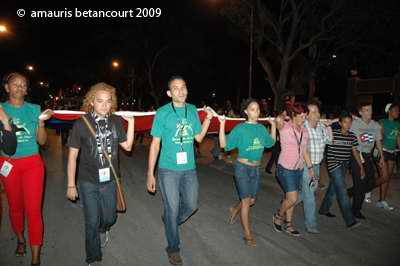
The May Pilgrimage organizing committee, Cuban and foreign delegates, and members of the Jose Marti art brigade, holding flags, guarded by two vehicles, one with a tree from Quebec, Canada, the other with a giant screen showing images of the last Pilgrimage edition, made their way across the river of people packed at the roomy XX Aniversario avenue, until finally reaching the two 18-story buildings not far from the Hotel Pernik.


The tree from Quebec was planted then and the Holguín Axe was raised up to the top of one of the two buildings.
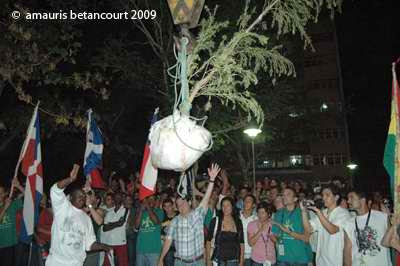
Then from a stage built for the occasion, Alexis Triana, top Culture official in Holguín, called the people for the coming 17th edition of May Pilgrimage.
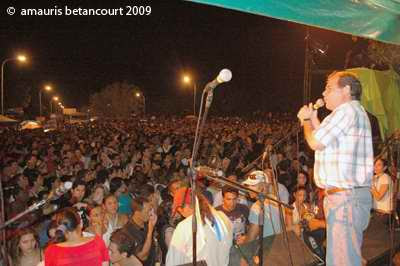
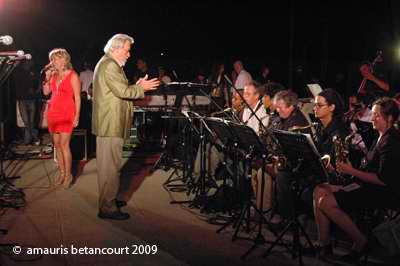
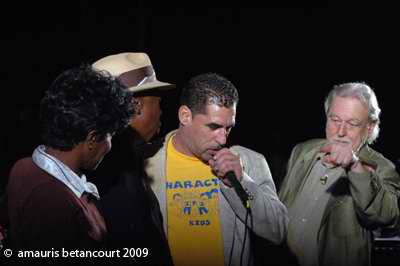
Later, there were combined and simultaneous performances for the peoples’ satisfaction. Several artists from the delegations that attended the Festival performed at the central platform, while at the Calixto Garcia Revolution Square the mythical Canadian musician Vic Vogel directed a long Canadian-Cuban concert, or quebecois-holguín concert, which was followed by the local band of Andy Clay, to finally close the day with Moneda Dura Saturday early in the morning.
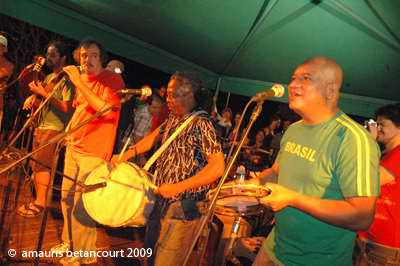
This was a bright ending to seven days of intense artistic events, from different manifestations, with people coming from all over Cuba and from different parts of the world. Holguín rejoices and keeps alive the hope of holding an International Festival of Artistic Youths within the already famous May Pilgrimage.

lunes, 11 de mayo de 2009

The Value of the Image Made Word

By Alfonso of the Rosary and Betsy Cintra Friday May 08, 2009 alfonso@telecristal.icrt.cu

Photos: Kaloian Santos Cabrera.

(May. 08) The possible, talked-over and many times established dichotomies between journalism and literature are swept away with a flash-light by Kaloian Santos Cabrera in his exhibit “50 times Cuba”.

Forged the way of the daily newspaper Juventud Rebelde, he has known how to look for the short-lived in what is relevant, and the transcendent in everyday life.Kaloian comes to be that sort of rare avis's in journalism, since his words have also the graphic support, with a master complicity who makes sure an image is worth a thousand words.

The ones doing journalism, including those of the audiovisual world, can hardly notice the borders and the lack of visual perspective, while making the news. But Kaloian finds the significance in what the visible, in what is evident, but tinged in an aesthetic way.


Cuban flags play the lead role in different circumstances found by this photographer-journalist, with a prominence that surpasses lances, parades or crowded concentrations.

It is not common to find symbolism associated to a flag attenuated by ideology or history. Cuban idiosincracy emerges in the shape of banners, hanged from the necks of elementary-school students, in taxi bikes, in a simple chipped wall or linked to that so remote sea and protector.

Thousands of words would be able to enclose, perhaps, the intention to define those colors that stay in our idiosyncrasy, but fifty pictures go father, to the nourishing nation's confluence, where Cubans took shelter for the sake of the ones we loved.

The flag Cuban, despite epoch or country, has its own history. And backing all of us, we may not see it sometimes, but it will never slip by unnoticed. It has such an important history not to be seen and its simplicity is a true transparency translated in an obliged reverence.


Kaloian achieves his purpose highlighting one more time that essential things exist.

miércoles, 19 de noviembre de 2008

Fernando Gil’s Chidren’s Tutorship

Text and photos: Amauris Betancourt.

The Harlequin I Have Inside, new cultural meeting from the Provincial Center of the Performing Arts in Holguín, has two appointments monthly. It aims at paying homage to artists and fostering the interest for the puppet theater world.

“Gil”–as people prefer to call Fernando Gil Arias- “deserves the attention of all of my city’s cultural institutions,” says Ignacio Figueredo Parra, producer and director of the gathering, and adds “I believe the way a man honors his name as an artist is creating. There are many people who consider him an ACTOR”.

Gil graduates from his native Manzanillo’s teacher’s art school, in the province of Granma. He arrives in Holguin in 1979 to work as an art teacher for the local puppet theater. He founds later the Julio Antonio Mella theater group from the Cuban National Worker’s Union and the children Gil-Aya theater project. Gil, his surname; Aya, the word in Spanish for the one who takes care and teaches children.

Gil treasures the 2005 Holguin City Award. Although he currently works for and directs Holguín's Dramatic Theater since 2001, he has left footprints in television, the puppet theater and the attrezzo world.

Gil evokes his experiences, among good and bad memories, of over 30 years devoted to the stage with an aura of nostalgia. His character as the goat has marked him. Many call him so nowadays. He must interpret once two characters: first the goat and then the cock, but he forgets to change over the mask. His artistic experience and professionalism let him off the hook by taking advantage of the situation for the sake of the spectacle, but the anecdote is still remembered.

Performing arts people utter affection and admiration for Gil: The Puppet Theater from Holguin performs for him, the work The little Martina Cockroach; and he talks about the skills of puppeteers in comparison with theater player: the former must insufflate energy and credibility to the puppet; the latter, must do it directly with his body.
He recalls the Gil-Aya project as one of his most wonderful experiences. Children, according to the project, have an appointment with him and his collaborators in the Alba's ruins, the current homonymous Academy of Plastic Arts. Hundred of children meet there, but only a hundred of them could come in. The entrance of parents or adults is forbidden: children should be picked up four hours later.

The project proves to be quite polemic. Doctors suggest it to parents, but colleagues in art question it. Even so parents and doctors trust the meeting and the gathering earns besides followers, a good reputation from the artistic point of view.

Year Zero and Gods Listen from Codanza Ballet Co. are some of his contributions to the attrezzo world, that’s why Codanza plays for him too with Ode to the Devil; and so does also the Holguín's Chamber Ballet.

Eugenio Hernández Espinosa, José Antonio Rodríguez, Michaelis Cué and Ana María Paredes are included among his masters and friends, among the professionals who he looks up to.

Gil longs for a better future than the present for the puppet theater and for the performing arts in the city. There is a lamentable worn-out in some cultural institutions, he states; and they are no longer up to the aim they were created for as for the technological and artistic state.

The Harlequin I Have inside has had a happy beginning. The following gathering is already looked forward. The city has another cultural space to admire artists and to recreate the Cuban art.