Text and photos: Amauris Betancourt.

The Harlequin I Have Inside, new cultural meeting from the Provincial Center of the Performing Arts in Holguín, has two appointments monthly. It aims at paying homage to artists and fostering the interest for the puppet theater world.

“Gil”–as people prefer to call Fernando Gil Arias- “deserves the attention of all of my city’s cultural institutions,” says Ignacio Figueredo Parra, producer and director of the gathering, and adds “I believe the way a man honors his name as an artist is creating. There are many people who consider him an ACTOR”.
Gil graduates from his native Manzanillo’s teacher’s art school, in the province of Granma. He arrives in Holguin in 1979 to work as an art teacher for the local puppet theater. He founds later the Julio Antonio Mella theater group from the Cuban National Worker’s Union and the children Gil-Aya theater project. Gil, his surname; Aya, the word in Spanish for the one who takes care and teaches children.
Gil treasures the 2005 Holguin City Award. Although he currently works for and directs Holguín's Dramatic Theater since 2001, he has left footprints in television, the puppet theater and the attrezzo world.

Gil evokes his experiences, among good and bad memories, of over 30 years devoted to the stage with an aura of nostalgia. His character as the goat has marked him. Many call him so nowadays. He must interpret once two characters: first the goat and then the cock, but he forgets to change over the mask. His artistic experience and professionalism let him off the hook by taking advantage of the situation for the sake of the spectacle, but the anecdote is still remembered.

Performing arts people utter affection and admiration for Gil: The Puppet Theater from Holguin performs for him, the work The little Martina Cockroach; and he talks about the skills of puppeteers in comparison with theater player: the former must insufflate energy and credibility to the puppet; the latter, must do it directly with his body.
He recalls the Gil-Aya project as one of his most wonderful experiences. Children, according to the project, have an appointment with him and his collaborators in the Alba's ruins, the current homonymous Academy of Plastic Arts. Hundred of children meet there, but only a hundred of them could come in. The entrance of parents or adults is forbidden: children should be picked up four hours later.
The project proves to be quite polemic. Doctors suggest it to parents, but colleagues in art question it. Even so parents and doctors trust the meeting and the gathering earns besides followers, a good reputation from the artistic point of view.

Year Zero and Gods Listen from Codanza Ballet Co. are some of his contributions to the attrezzo world, that’s why Codanza plays for him too with Ode to the Devil; and so does also the

Holguín's Chamber Ballet.
Eugenio Hernández Espinosa, José Antonio Rodríguez, Michaelis Cué and Ana María Paredes are included among his masters and friends, among the professionals who he looks up to.
Gil longs for a better future than the present for the puppet theater and for the performing arts in the city. There is a lamentable worn-out in some cultural institutions, he states; and they are no longer up to the aim they were created for as for the technological and artistic state.

The Harlequin I Have inside has had a happy beginning. The following gathering is already looked forward. The city has another cultural space to admire artists and to recreate the Cuban art.


 And these verses are useful, extrapolating them, for my referring them to the photographer's art: it is not because we see his photographs; it is essentially and significantly because we bear out he sees. Seeing means will, sensitivity, awareness of a perspective and a utility.
  The photo exhibit, which is being opened to everyone’s wanting-to-look-at-it eyes, is meant to pay homage to the most decisively turning point in our country's history, the triumph of the olive-green Revolution.
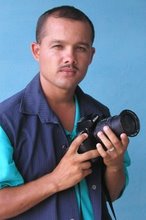
 The young photographer Amauris Betancourt climbs so a higher step in his short but well en-route career, which already includes no few achievements.
 A conscientious look is observed in the photographer works; mindful of what it happens in the ever-changing daily life, of the gestures revealed in men in his acting on earth.
  The exhibit is made up of 50 photos picked up after a hard work of decanting, very complex if it is taken into account that a reporter's work piles up images with an almost exponential increase. It grows up with the passing of days due to the tuning of his perspicacity, the familiarity with the occupation and the rooting of an ineffable need of catching instants. But, as he had to arrange sort of a panorama to show, rather than the art of the photographer, the art to produce a country during half a century – it does not mean leaving out quality while choosing –, because the artist has imposed strict boundaries.
 However, Amauris succeeds. Different contingencies, one way or another, of a group of human beings are portrayed here while making an effort and displaying their potential in divergent uneven existence paths: work, study, art, sports, recreation. That is, the assortment of life.
  Taking a good look three subjects are dealt with and brought once and again to the surface repeatedly making up the exhibit’s spinal cord. In the first place, human groups. Even though there are some excellent photos dedicated to personalities of the culture – Mario Kindelán, Silvio, Nicolás de la Peña, Estela, Solás, Frank Fernández –, priority is not set on individuality, but on the movement of human groups.

 The third subject, no less interesting, touches on gestures synthesizing an existence's significant element. The sports hero to the shade of another greater hero, with equal meditative attitude; the hands of the reporter fixing the data that will become later the news touring the world over; the artistic director or the audio technician paying attention meticulously to what he does; the barber fulfilling scrupulously his role while reflecting the elapsed time; the elementary school student sleeping with a watchful flag in her cheek; the rude hand holding the trimming hook in the break amid work.


 Amauris defines very accurately his subjects. He uses properly framing to expose what he aims at and to avoid undue ambiguities. He likes the contrasts of lines, as well as the shades of light revealing the dynamics of the photographed object. In short, he knows how to demonstrate the intentionality that moves him, because without it there is no art.


 Alta Marea, on the other hand, definitely made it to Holguín. It is linked to his passion for literature and poetry, and for local writers. That half-way sickly devotion took him to found a space thought to join friends, to fuse poem and song.
  Alta Marea is named after the title of one of his songs, included in the recently Como una luna en pie (Like a standing moon) CD.
 The gathering is on Thursdays, at the dying afternoon as Sindo Garay would say. The last guests have been writers Rolando Bellido, Lourdes González and Delfín Prats. The environment is pleasant. And it would be better if fans could put apart routine and meet there enthusiastically to have a ball for a while listening to Life trouba music and true poetry.
 Sponsored by ARTEX (a Cuban art promoting institution), and the Book Provincial Center, the gathering was inaugurated in Holguin last October 2, with guest poet José Luis Serrano.
 Cabreja was then already anxiously expecting the results of his concert at the
 The jury wishes to acknowledge this contest is an evidence of the efforts accomplished by the


