Mostrando las entradas con la etiqueta Cuban photography. Mostrar todas las entradas

lunes, 24 de octubre de 2011

Cuban Nacional Ballet Performs in Holguín


By Amauris Betancourt.

The Cuban National Ballet (BNC) presented this Sunday in the sold-out Eddy Suñol theater a program to be repeated today at 9:00 p.m.
 
Five pieces were interpreted by young members of the BNC who pleased the audience with the choreographies Muñecos by Alberto Méndez, Majísimo by Jorge García, Dionaea by Gustavo Herrera and Dialogo a 4 by Alicia Alonso.


The BNC’s last performance in Holguín took place in the 80s. This time the program is dedicated  to the Ibero-American House and to the IV Encounter of  International Solidarity Art Brigades taking place now.

viernes, 1 de julio de 2011

Car Purchase-sale at the Corner in Cuba

By Amauris Betancourt.
 
Oldtimer on sale in Bayamo city.

The 6th Congress of the Cuban Communist Party (PCC) would have been much more successful if, in its closing day, it had been announced immediately the car purchase-sale policy as well as the housing one, at least.  
I do not take away at all any political importance to the event, neither tone down the transcendental aspects discussed. I only remark the fact it has to do with two very hoped-for measures. They should have been checked earlier so that many illegalities would have been avoided.  

Their legal implementation urges despite the juridical difficulties it may run into. They should help dynamite other advertised changes, though caution proves to be prudent. Common sense will go its way putting it right  with time, as it has to be done with some other measures already implemented like the Supply and Demand Law applied to means of  transportation where the “who he offers rules”-policy reigns.


Oldtimers in Santiago de Cuba city.


 Oldtimers in Holguín city.


lunes, 23 de mayo de 2011

Ration Book Contradicts Distribution Principles in Socialism.

Photos by Amauris Betancourt.
Raul Castro Ruz, President of the Council of State and the Council of Minister of the Cuban Republic and First Secretary of the Cuban Communist Party (PCC) stated, in the Central Report to the 6th Congress of the Cuban Communist Party:

“Undoubtedly, the ration book and its removal spurred most of the contributions of the participants in the debates, and it is only natural. Two generations of Cubans have spent their lives under this rationing system that, despite its harmful egalitarian quality, has for four decades ensured every citizen access to basic food at highly subsidized derisory prices.”

“This distribution mechanism introduced in times of shortages during the 1960s, in the interest of providing equal protection to our people from those involved in speculation and hoarding with a lucrative spirit, has become in the course of the years an intolerable burden to the economy and discouraged work, in addition to eliciting various types of transgressions.”

The leaflet including the Guidelines of the Economic and Social Policy of the Party and the Revolution passed last April 18th, states in the chapter on Social Policy:

174. The implementation of a slowly and gradual elimination of the Ration Card as a way of equal and controlled distribution at highly subsidized prices.”

Ration book store in the municipality of Rafael Freyre.

 Ration book store in the municipality of Holguín.


lunes, 13 de abril de 2009

Gibara, the Crabs's White Village

By Amauris Betancourt.
Gibara, the beautiful coastal head city from the municipality named likewise in the province of Holguín, at Cuban Northeastern, was founded back in January 16, 1817. It is also known as the White Village.
Gibara is noted for its history, culture and its biodiversity in its flora and fauna, in addition to the architecture that turned it into National Monument in 2004.The railroad, introduced in 1893 from Holguín, brought Gibara commercial prosperity. It lives now on cattle raising, agriculture, fishing and tourism.

The city, – with its generous, solidary, affectionate and a little proud people -75 thousand inhabitants spread in 630 square Km.–, hosts every year, since 2002, the International Non-Budget Film Festival founded by deceased Cuban moviemaker Humberto Solás.

Calixto García park, old military square.

A replica from the Statue of Liberty, in the center of the Calixto García park, dedicated to mothers.The Museum for Colonial Arts among the most important collections of the country. The Parish Church embedded in the Calixto Garcia park.
The Batería Fernando VII turned Gibara into the second walled city in Cuba to protect the city against the attacks of corsairs and pirates.

Gibara Bay houses a port since 1822.

Recently, the overnight from September 7, 2008, an ungrateful guest destroyed The Village Blanca: the hurricane Ike.

JotaCruz wins Prizes in First Photonature Contest

By Amauris Betancourt.

Juan Miguel Cruz Gómez, JotaCruz, won the first and second prizes in the First Photonature Contest, Holguín 2009, while Raciel Cruz Peña, from the new generation of photographers, got the third award, made public during the inauguration ceremony at the Electa Arenal ward from the city Art Center. The series Life in the Birama Wet Lowland, by JotaCruz, depicts –in excellent compositions, from different angles and in the right moment- different places and species from Birama Wet Lowland at the province of Granma. Biodiversity, the second rewarded piece by the same creator, approaches, in portraits, endemic birds from the area of Cupeycillo, located at the municipality of Gibara. The photographer feasts on the beauty and charisma of these endemic birds turning the area into a meeting place for scientists, photographers, painters, naturalists and birders.

Raciel Cruz Peña got the third award with Equilibrium, where he goes beyond the natural hedonism of our Cuban fauna and the use of good photographic technique, to a symbiotic message of communion between human beings and animals on Earth. The jury board, presided by Nils Navarro and made up besides of photographers Amaurys González and Juan Pablo Carreras, awarded too four Mentions: Carlos Alberto Ferrá for A day after, and to Luis Catalá Gurri, William Lucas Rodríguez and Alexander Sánchez Rivas for their works Hope Nets, The alert spectator and First Steps, respectively.

Nils Navarro, the photocontest president, decided to acknowled the support from Trimagen and Photo Service in the printing process. He also stated his desire to have a yearly Photonature Contest to call society’s eye on the protection of the environment and the Cuban flora and fauna.

The exhibit hosts 61 photographic works from 32 professional and amateur photographers including visual art students. It will be open to the public for a month and will be shown next in Gibara during The Community Festival “Protecting Birds” from May 18 to 24 sponsored by several national and international institutions.

viernes, 20 de marzo de 2009

Fresh Start and New Cycling Tour

By Anneris Ivette Leyva (taking fron Granma).

Camera photo bags tests physical capacities of men and women; even though they are a bit empty, they weigh a lot. Marisol is not afraid of loads, though. She tries to keep in good shape.
She showed enough dexterity to follow the rhythm of cyclists in the recently concluded Cuban Cycling Tour, an edition that shed so much bright in medals and sports deeds as in transgressing sexist stereotypes, usually a patriarchy favoring male photojournalism. Although she misses sometimes walking light or showing off a little, delicate, acceptable purse, she accepts without exasperation the rigors imposed by the art of photography, not wearing skirts or gowns included.

“When one is in love, like me with photography, it is unable to see shortcomings”, she explained while digging into her jam-packed briefcase, where camera accessories and lens, and toilet powder and lipsticks live together. “I was always the photographer at family and friend gatherings. The fact to capture image as a remembrance for future generations seduced me.”, she evokes.
The professional practice was a self-imposed challenge, a go against the crowd. "I felt excluded in the beginning, mostly by people off mass media milieu. They did not figure out what a woman had to do in such a job. But things changed when I was admitted in the Cuban News Agency at the correspondents' office in Matanzas. I found a lot of support among my colleagues". Having turned a deaf ear to prejudices and achieved recognition in a sector with masculine prevalence was not enough to undertake another boldness. With almost 25 years, Marisol Ruiz Soto was able to become the first woman in photographing the Cuban Cycling Tour.
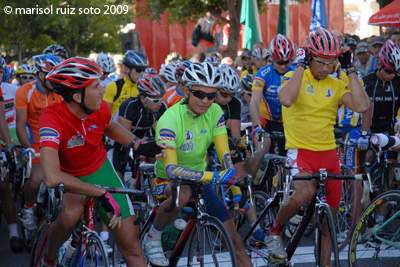
"The adventure is certainly hard and dangerous, because we had to travel by motorcycle all the time, and at high speed. But if so many men can make it, why might not women? Besides, the group of reporters was very attentive to me. They welcomed me naturally and helped me very much.”

“One of the most difficult things in journalism coverage is parting, being far from home and family. But when the purpose to do what we like prevails, we overcome difficulties”, says this young enthusiastic girl that does not deny taking as an example three exemplary women to confront daily challenges.

Two of them are very special for all Cubans: Vilma Espin and Celia Sánchez. "The both achieved, with sweetness and decisiveness at the same time, to raise women’s position to their due place. The third woman is Marta Soto, my mom".
In that list of worth remembered achievements from the 14th Cycling Tour, the feminine performance, a decreasing process, Marisol has been able to implant a fresh start.