Mostrando las entradas con la etiqueta Gibara. Mostrar todas las entradas

miércoles, 13 de agosto de 2014

Gibara I: While Waiting

Gibara is always a temptation to photograph. It is impossible to keep the lens covered. Thus pictures were taken as I waited, strolling around, for the III Stereo G Electronic Music Festival to kick off.
The aeolic park, wind mills to produce energy, is becoming a symbol of this sea village. They are located in the way to Caletones beach. Foto: Amauris Betancourt.
Céspedes street in Gibara. Slogans on walls can render quiet iconic when put together in a picture with other elements of the cityscape. Foto: Amauris Betancourt.
 
The sculpture facing the sea has a thing about it that gets the eye. Foto: Amauris Betancourt.
 
Beach at the city way in, driving from Holguín, used a post by the camping site entereprise. Foto: Amauris Betancourt.

domingo, 26 de agosto de 2012

Tropicla Storm Isaac Leaves Cuba Behind

Text and pictures: Amauris Betancourt.

The tropical storm Isaac have already left Cuba behind through Guardalavaca beach resorts but I would like to share some images before and after its going through in Holguín and in Gibara.

In Holguín:

 In Gibara:

FOR MORE PICTURES WITH ENGLISH FOOTAGE GO TO: http://mauroflash.blogspot.com/2012/08/isaac-efectos-en-holguin-y-gibara.html

jueves, 23 de junio de 2011

Gibara City, a Fortunate Nature


By Amauris Betancourt.

Gibara city is often related to being an attractive and beautiful port city. That is true. But its natural charms are rarely referred to.  The treasured biodiversity calls the eye (lens) of photographers, amateur and professionals, to whom it is not difficult to make time stop in an instant of the flora and fauna because of the inherent photogenic, rural and city milieu.

The Cupeycillo (a rural place) ecosystem hosts endemic bird species and houses too corridors to migrant birds that frequently make a staying in given seasons.
Carpintero jabao o Meladerpes supecidiario.

Cartacuba o Todus multicolor.

Cartacuba o Todus multicolor.

Siju platanero.

 
Gibara Bay with a view of Gibara's Saddle hill.
 Gibara Bay’s grace bewitches: I do not believe there is a person who, lens in between, opposes resistance to press the shutter; though there are many regretting not carrying a camera with to take the city in a shot ¿Any doubts?
Gibara Bay with a view of Gibara Saddle hill.

Gibara Bay at dawn.

Gibara Bay.
Gibara Bay.

martes, 14 de abril de 2009

Inauguration Day from VII Humberto Solás Non-Budget Film Festival in Gibara

By José Miguel Ávila.
Photos: Amauris Betancourt.
Sergio Benvenuto, Film Festival director, reading inauguration words.

The usual participants inauguration parade, the fireworks, the movie screening of Humberto Solás’ A November’s Day (1972), and the inauguration concert by afro-rock group Síntesis marked out the first day of the VII Humberto Solás Non-Budget International Film Festival in Gibara.


lunes, 13 de abril de 2009

Gibara, the Crabs's White Village

By Amauris Betancourt.
Gibara, the beautiful coastal head city from the municipality named likewise in the province of Holguín, at Cuban Northeastern, was founded back in January 16, 1817. It is also known as the White Village.
Gibara is noted for its history, culture and its biodiversity in its flora and fauna, in addition to the architecture that turned it into National Monument in 2004.The railroad, introduced in 1893 from Holguín, brought Gibara commercial prosperity. It lives now on cattle raising, agriculture, fishing and tourism.

The city, – with its generous, solidary, affectionate and a little proud people -75 thousand inhabitants spread in 630 square Km.–, hosts every year, since 2002, the International Non-Budget Film Festival founded by deceased Cuban moviemaker Humberto Solás.

Calixto García park, old military square.

A replica from the Statue of Liberty, in the center of the Calixto García park, dedicated to mothers.The Museum for Colonial Arts among the most important collections of the country. The Parish Church embedded in the Calixto Garcia park.
The Batería Fernando VII turned Gibara into the second walled city in Cuba to protect the city against the attacks of corsairs and pirates.

Gibara Bay houses a port since 1822.

Recently, the overnight from September 7, 2008, an ungrateful guest destroyed The Village Blanca: the hurricane Ike.

viernes, 26 de septiembre de 2008

A Second Hit to Gibara after Ike Hurricane

, By Leandro Estupiñán / leandro@ahora.cu
Photos: Amauris Betancourt. / amauris@radioangulo.icrt.cu


I happened to overhear it last Wednesday when the Director of Culture in Holguin was being told: the man to whom Cuba owes the International Non-Budget Film Festival of Gibara had just passed away.

Humberto Solás, one of the most important national moviemakers, director of films such as the representative Lucia (1970), Cecilia (1982 and 1983) and A Successful Man (Un hombre de éxito) (1986), paid a visit to Holguín in April during Gibara´s Movie Festival (founding president), a film meeting that, thanks to his perseverance and commitment, has become an international gathering for low-budget movie producers.

He chose the sea city of Gibara because he arrived there one day to film one of Lucia’s stories. It was the life of a woman fighting against a male chauvinist society, but in Revolution; that is, according to his meaning, in constant change.

Gibara ended up then a fetish plateau ever since, in the same way actress Adela Legrá was fetish. He went back to Gibara later to film one of his latest movies: Miel para Ochún (2005), an example of what he considered a low-budget film. He said it many times: it is a cinema carried out with few resources, but with a high artistic, aesthetic and meaningful sense.

It was his last bet. He began filming that last film one day in 2002. There was no script, but lots of cameras. The boys attending the Festival brought them along with. They wanted to learn from their masters. They had believed in the call without thinking it over that much.

To Gibara's city, a city like Havana but without sprouting, musicians, moviemakers, actors, painters and international personalities arrived. Enthusiasm reigned then. Rumor had it that an important visitor, the Spanish composer Joaquin Sabina, was to come. Regrettably, Sabina did never arrive, but his absence was forgotten one night amid fireworks when everybody seemed to sing: it is worse for the sun...


Solás did not shout either Action; however, he began filming himself: neophytes’ visits to movies, experts’ conferences about short and full-length films, homages to famous moviemakers were recorded for ever. Gibara was the starting point for people to go anywhere in the world, and from that anywhere, people came back to Holguin. It was precisely there where memoirs of his National Movie Prize Awarding were engraved in 2005.

He was taken once to the corner of Mártires and Frexes streets to witness a new building. A coffee-shop emerged there. It was The Tres Lucias coffee-shop named after his 1970 movie. The city paid reverence so to the artist and to Cuban movie. The coffee-shop, a popular space today, showed up large scale posters of the three actresses starring in the memorable film Lucia, among the top-ten best Ibero-american. A pleasant environment was breathed, bathed by the coffee aroma and soundtracks of known movies. Everything was doing all right till Humberto Solas made out three small busts in the corner. He got closer and realized they were replicas of Cuban moviemakers Santiago Álvarez, Titón and of himself. He did not like the honor and the bust made after him, reproducing his face, had to be withdrawn. He was not dead yet.


Solás was a vital man and he filmed a movie, the man's film lifting to outstanding places the art of third world countries, the movie of the Island of Cuba. He had summoned his friends and he had no end in mind. He had a lot to say left. There was not much time. The film is not over yet today, and Solás has not yet either ordered the conclusive Cut!


This place served as one plateau for a scene in the film Lucia.

sábado, 20 de septiembre de 2008

Ike Hurricane Erases a Village in Gibara

Text and photos: Amauris Betancourt.
amauris@radioangulo.icrt.cu

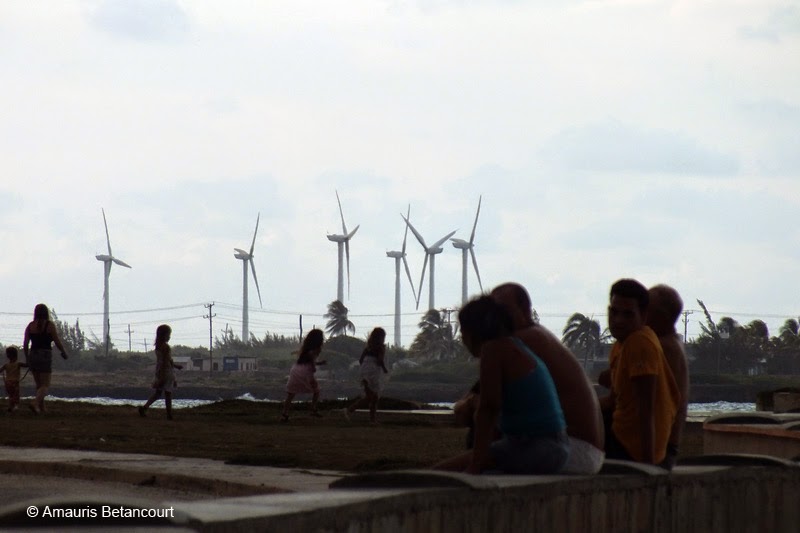
Gibara, Holguin.- El Guirito, a fishermen village located between the eolian power generator site and the city of Gibara, was practically swept away overnight, while being hit by Ike hurricane last September seven.
Inhabited by fishers its dwellers were evacuated during the hurricane’s informative phase. The settlement, to the entrance of Gibara's Bay, lacks a sea wall that could have protected the area to some extent. It was therefore quite easy for Ike hurricane to invade it with its strong winds and pave the way for the sea waters to wreak havoc on all buildings way in.
School in the "El Güirito" village.
The settlement got reduced to debris and one or two isolated walls. Only a few houses outlived the impetuous hurricane.

Some dwellers are still evacuated because many people from this municipality, which almost evacuated 3 thousand 500 people out of its 73 thousand inhabitants, almost half of its current population, lost their places.
The old city of the White Village of the Crabs, as they also call Gibara, was not badly damaged. Only those areas closer to the sea, and mainly the sea wall, destroyed in several segments.
Gibara recovers, nevertheless, like all affected areas in the island, but slowly because damages are considerable and resources are scarce.