Mostrando las entradas con la etiqueta photography. Mostrar todas las entradas

jueves, 23 de junio de 2011

Gibara City, a Fortunate Nature


By Amauris Betancourt.

Gibara city is often related to being an attractive and beautiful port city. That is true. But its natural charms are rarely referred to.  The treasured biodiversity calls the eye (lens) of photographers, amateur and professionals, to whom it is not difficult to make time stop in an instant of the flora and fauna because of the inherent photogenic, rural and city milieu.

The Cupeycillo (a rural place) ecosystem hosts endemic bird species and houses too corridors to migrant birds that frequently make a staying in given seasons.
Carpintero jabao o Meladerpes supecidiario.

Cartacuba o Todus multicolor.

Cartacuba o Todus multicolor.

Siju platanero.

 
Gibara Bay with a view of Gibara's Saddle hill.
 Gibara Bay’s grace bewitches: I do not believe there is a person who, lens in between, opposes resistance to press the shutter; though there are many regretting not carrying a camera with to take the city in a shot ¿Any doubts?
Gibara Bay with a view of Gibara Saddle hill.

Gibara Bay at dawn.

Gibara Bay.
Gibara Bay.

lunes, 11 de mayo de 2009

Cuba in the Lens of Bernd Harnisch

By Amauris Betancourt. amauris@radioangulo.icrt.cu

(May. 06) The portrait made a very important contribution to popularizing photography, born in Europe during the Enlightenment and the Industrial Revolution. Portraits were not precisely the first images made, but they had much to do with bringing this new technique closer to the people due to its high demand based on reflecting a real image and not a recreated one as in painting.

Making portraits is an art indeed. The first famous photographers devoted to it as such, but based on pictorial compositions to give it aesthetic, a category limited only to painting. This way the portraitist, and the corresponding gender, is the most prolific activity in the art history of the lens.

Then exhibiting portraits and revealing a new thing is quite difficult, but not impossible. Bernd Harnisch, a German photographer living in Holland, comes to Cuba, attracted by the 2009 May Pilgrimage, to show "People and Landscapes" in a photographic proposal going beyond candor.

Harnisch doesn't make things too complicated with deliberate compositions. He is devoted to taking pictures and does without conventions; however, he achieves an aesthetic recompense because he unveils Cuba with psychological and aesthetic tact from the view of a foreigner, not as a tourist that who comes just for pleasure, because Harnisch doesn't only make the picture, he writes rather a story and later hangs the picture. He first looks for the empathy of the photographic technique, and above all, readings in between, he comes closer to the topic.

He takes pictures of people and landscapes, and then backs his photos with brief, interesting stories, direct and allusive; and without maybe intending so, he gets close to Cuban idiosyncrasy. The reward comes in close-ups whose creativity relies on photographing beyond the physical image of a face.

The author of "People and Landscapes" rides on his bicycle all over the country, from Guantánamo to Havana, attentive to the daily thing that may go by unnoticed to a local photographer. He recreates this way a social history through that image of a "Hotel left in ruins," a reminiscence of Cuban colonial architecture, capitalist in service; or that "Stairway" kind of copy of opulence. Or the beautiful colonial village of "Gibara" in its ordinary social landscape. He doesn't leave out Cuban music seen in a "Rapper in Holguín," and jumps to sport in the "Maybe the best black Latin-American chess player," taken out of the streets of Santiago de Cuba, who he has not been able to defeat in a match.

Bernd Harnisch includes the "Curious neighbor, and "The "Family that welcomed me when there was no hotel for me to spend the night, or the "The helpful office worker who told him where to fix the tire of his bicycle", as well as the "Solicitous Salesperson" and the "Children."

Harnisch portraits in a singular way and maks justice to the Island he loves.

lunes, 13 de abril de 2009

JotaCruz wins Prizes in First Photonature Contest

By Amauris Betancourt.

Juan Miguel Cruz Gómez, JotaCruz, won the first and second prizes in the First Photonature Contest, Holguín 2009, while Raciel Cruz Peña, from the new generation of photographers, got the third award, made public during the inauguration ceremony at the Electa Arenal ward from the city Art Center. The series Life in the Birama Wet Lowland, by JotaCruz, depicts –in excellent compositions, from different angles and in the right moment- different places and species from Birama Wet Lowland at the province of Granma. Biodiversity, the second rewarded piece by the same creator, approaches, in portraits, endemic birds from the area of Cupeycillo, located at the municipality of Gibara. The photographer feasts on the beauty and charisma of these endemic birds turning the area into a meeting place for scientists, photographers, painters, naturalists and birders.

Raciel Cruz Peña got the third award with Equilibrium, where he goes beyond the natural hedonism of our Cuban fauna and the use of good photographic technique, to a symbiotic message of communion between human beings and animals on Earth. The jury board, presided by Nils Navarro and made up besides of photographers Amaurys González and Juan Pablo Carreras, awarded too four Mentions: Carlos Alberto Ferrá for A day after, and to Luis Catalá Gurri, William Lucas Rodríguez and Alexander Sánchez Rivas for their works Hope Nets, The alert spectator and First Steps, respectively.

Nils Navarro, the photocontest president, decided to acknowled the support from Trimagen and Photo Service in the printing process. He also stated his desire to have a yearly Photonature Contest to call society’s eye on the protection of the environment and the Cuban flora and fauna.

The exhibit hosts 61 photographic works from 32 professional and amateur photographers including visual art students. It will be open to the public for a month and will be shown next in Gibara during The Community Festival “Protecting Birds” from May 18 to 24 sponsored by several national and international institutions.

jueves, 15 de enero de 2009

The Skins Discovering us

By Aracelys Avilés
araa@ahora.cu
The body scars take us almost always down to some point in our own existence. They drive us down to a history that marked us, much or little, but they its existence serves as an evocation to an anecdote or a memory. “The skin of the children of Gaia” makes reference to precisely that force of the human body to express an identity, a way of being and feeling.The Spanish curator Amador Griño is this project’s ideologist in which two fellow countrywomen's discourses get together: photographer Isabel Muñoz, with a series of photos and Sculpture Maribel Doménech.
“The used material conditions me because it can hurt”, said Maribel to describe her daily work. She uses electric wires to weave clothing to the middle age style. The one shown at Holguin Art Center weighs some 250 kilos. “It is kind of a body discourse where it can be seen in its emptiness”, Griño added.Isabel shows, in her large-sized photos, the naked body, painted, marked, according to two Ethiopian tribe’s member’s idiosyncrasy, for whom the skin stands as an idol.
The opening of the exhibit took place at the Holguín Art Center has already been filed as a great event of cultural integration. It has been possible thanks to a joint work of Holguín Council of Visual Arts and its national homologue as well as the Spanish Embassy in Cuba and the CEASEX.
This travelling exhibit has toured the entire South America and the Caribbean and lands in Cuban through Holguín, where it will remain till March 5th when it will be taken to Santiago de Cuba and Havana.

jueves, 8 de enero de 2009

Photography Fosters Compliments to Personal Merit

By Jose Antonio ChapmanPérez

I admit –in almost 25 years of work in the exciting world of chronicles, comments and news reports- not having paid enough conscious attention to the photoreporter’s work.

Photoreporters are artist who perceive, fix and illustrate daily life with objectivity for the sake of the world tangible picture. We should agree then to echo the legacy of José Martí, our national hero, when he stated: “The opportune compliment fosters recognition”.

Acknowledgement stirs up imagination when checking firsthand the surpassed lyricism in the vital support of the image to a news report, an interview, or a chronicle; and in a photographic exposition.

Without fostering Chauvinism, in Holguín there are excellent press photographers. I would include Elder Leyva, Yusleidis Socorro, both of the weekly paper Ahora!; Juan Pablo Carreras from the Cuban News Agency; Amauris Betancourt, from Radio Angulo Digital; Juan Miguel Cruz, from the national weekly sports Jit. Of course not leaving out the TV cameramen from the local Tele Cristal broadcasting station.
Amauris, with a highlighted work despite his youth, is able to deliver a truly photographic gift where life is turned into news stories. His originality towers itself over criticism and undue diatribe. He is only small physically.
These arguments backs up the objective praise in the full-of-life photo exhibit “Holguín: 50 Years of Revolution” at the CMKO Radio Broadcasting Station's gallery, where it can be appreciated.
Juan Miguel is another lens talent maker of wonders, and is currently making sports photography; but he goes in too for nature photography besides daily photojournalism. The approach to this assessment comes true at Radio Angulo's Web site, where both professionals add pictures to different news genders in the published works.
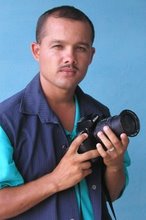
It is written and spoken of professions frequently and at times conventionaly, but very little is said about photoreporters. I just want to pay humble homage to this beautiful memory-perpetuating work.

miércoles, 19 de noviembre de 2008

Pope John Paul II in Holguin

By Leandro Estupiñan.
Photos: amauris Betancourt.

In January 1998, for the first time in the nation's history, the Pope from Rome reached Cuba.

John Paul II had been invited to the Island by the government and, the pontiff, in his enthusiasm to take the church's legacy to every world’s corner, came once and for all.
Ten years are already gone since then and a photograph exhibition tours the country to recall the event. The photos belong to Arturo Mari, personal photographer from the Polish that, before taking over his duty in the Vatican, was named Karol Wojtyla.
Saint Isidoro Cathedral housed for a week the exhibit at the public’s disposal. Mari was born a few meters away from the Vatican, and was marked since his childhood by the closeness to the heads of the Catholic church.
He stayed by John Paul II for a good part of his life. He kept him company so from the early morning to late evening hours.
He followed him to Cuba during his journey in 1998. He witnessed and recorded the trip in 51 photographs out of which 31 were shown in the first Cuban city where this Pope's effigy was erected. A representative of the Order from Malta in Cuba and Luigi Bonazzi, papal nuncio, attended the inauguration.

The photographic exhibition brought back to mind the trip to Cuba of a man who practiced sports, devoted himself to art and seemed to have, like none of his ancestors in front of the church, a memorable sense of humor.He was also such a fair and human man that almost six hours before he passed away he had his old photographer Mari called, not to ask him for a portrait, but to simply say: “Thank you very much for every thing”.

sábado, 9 de agosto de 2008

Felix Arencibia: a Teacher for Life, a Very Close Friend (Versión en español disponible)


By Amauris Betancourt.
amauris@radioangulo.icrt.cu

The Cuban photographer Felix Arencibia’s death surprised the photo world in the Island. This chronicle was published on hearing from his death.

Felix Arencibia, our Arencibia, has left us physically. The news of his passing away could hardly be believed. The day before he was admitted in the hospital, he put me in touch solicitously with the photographer Roberto Salas from whom I needed a collaboration for La Luz, a cultural weekly from Holguin.

Arencibia was always so: openhanded, solicitous, affectionate and helpful to others as a friend; competent as a professional; engaging and contagious when it came to photography out of the love he had for the art and technique patented by the French Louis Jacques Mandé Daguerre.

Holguin’s Photography Club, his closest colleagues, photoreporters all over Cuba, commercial photographers included, were deeply surprised to hear to news.

Desperate due to our distance from Havana, where he lived, we could only have him bought a funeral wreath as a symbol thanks to the brotherly friend Rufino del Valley. A formal gesture compared to the big, truly friendship Arencibia privileged us with.

His long and rich career turns a legacy of dedication and endeavor, an example to the Cuban photo press world. But more than that, he gave us his knowledge that never kept for himself. Always offering because it was better giving than receiving, he taught because he also learned thus.

Those who love photography found an oasis in Arencibia to please our thirst of knowledge; a converging nest at Jose Marti International Journalism Institute, a meeting place for inland photographers while visiting Havana.

Juan Miguel, Juan Pablo, Elder, Edgar, Kaloian, Roy González, Héctor Luis, the namesake Amauris, and other grateful people from Holguin, me included, will miss his friendship, his tireless way of speaking, his timing piece of advice, his everyday e-mails with the most updated news related with the world of photography, his invitations to workshops in Havana, the spaces and opportunities he put at our disposal.

The Jose Marti International Journalism Institute, and Havana, will have a different tinge without him. Felix left us physically. We, however, will bear him in mind and it will be difficult to get used to the habit of his departure, a surprised to him amid all those yearly workshops administer by him. His darkroom was our darkroom! Thanks Arencibia!